
Imagine regarding the brewing process as a precise symphony, where the quality of each instrument determines the smoothness and shock of the entire performance. The high-quality beer brewing equipment is precisely the top instrument of this performance, and its most direct performance improvement is reflected in thermal energy and energy utilization. A set of mashing and boiling equipment equipped with an efficient heat recovery system can reduce steam energy consumption by up to 40%. For instance, 85% of the latent heat can be recovered by condensing steam for preheating brewing water. This means that for every 1,000 liters of beer produced, the energy cost can drop from an average of $15 to $9. A report from a craft brewery in the United States with an annual production capacity of 50,000 barrels shows that after investing in such systems, its annual energy costs have decreased by more than 60,000 US dollars, and the payback period has been shortened to 24 months. The heat transfer efficiency of the equipment has been increased by 15%, precisely compressing the boiling time from 90 minutes to 60 minutes. This not only boosts the batch turnover rate by 20% but also reduces the evaporation of heat-sensitive aroma substances by 30%, thus preserving the soul of the beer.
Time is output, and high-quality beer brewing equipment is the master of time. The automated control system can achieve one-click saccharification, transforming the traditional complex process that relies on the experience of experienced masters, takes 8 hours and has a 5% operational deviation into a precise and repetitive standard operation that only takes 5.5 hours and has a parameter deviation of less than 1%. This has shortened the batch production cycle from an average of 7 days to 5 days, equivalent to a potential 28.5% increase in production capacity. Studies show that in wineries with integrated automated mashing systems, the equipment utilization rate can be increased from 65% to over 85%. For instance, Heineken, in its global intelligent factories, synchronously manages over a hundred fermentation tanks through a central control system, reducing the fluctuation of the fermentation cycle by 70% and achieving a stable annual output of over 100 million hecoliters. This improvement in time efficiency directly translates into the agility of market supply and the rate of cash flow.
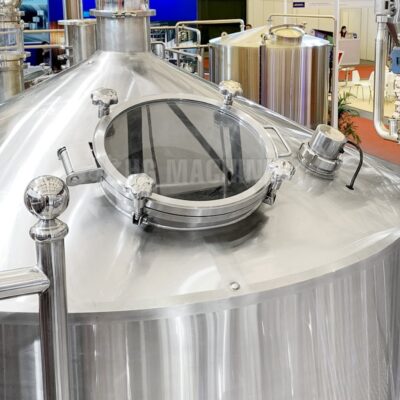 In the dimension of quality control, high-precision equipment is the cornerstone for eliminating waste and enhancing extraction efficiency. The inner wall polishing accuracy of a mashing pot reaches Ra≤0.6 microns. Combined with a precise temperature control system (with an error of ±0.2°C), it can stabilize the starch conversion rate at over 98.5%, and the fluctuation range of the original wort concentration is reduced from ±0.8°P to ±0.2°P. This means that each ton of malt can produce approximately 5% more available wort, and the raw material cost can be reduced by about 3%. In the filtration process, a high-performance diatomite filter can keep the beer loss within 1.2%, while inefficient equipment may result in up to 5% of the precious beer being discarded as residue. For a distillery with an annual output of 100,000 liters, this is equivalent to recovering over 3,800 liters of finished products each year, directly increasing profits by tens of thousands of dollars. This meticulous control over every drop of material is the most direct financial manifestation of efficient brewing.
The deep integration of automation and intelligent monitoring liberates human labor from repetitive work and shifts it towards higher-value process optimization. A complete set of automated beer brewing equipment production line can realize 3,000 data points per day for online monitoring of specific gravity, temperature and pressure in the fermentation tank, and predict the fermentation endpoint through algorithms, reducing the frequency of manual sampling and detection by 80%. This avoids at least 15% of the contamination risk introduced by open-can sampling. On the filling line, high-speed filling machines are equipped with laser detection and automatic rejection devices, which can control the filling capacity accuracy within ±5 milliliters and reduce the rate of filling non-conforming products from 0.5% to below 0.1%. Industry analysis indicates that comprehensive automation transformation can reduce the number of operators required for a production line from 12 to 4. Although the initial investment may increase by 30%, the overall return on investment (ROI) can turn positive within 18 to 36 months, considering the savings in manpower, losses, and quality premium. Therefore, investing in high-quality equipment is not merely about purchasing steel containers; it is about acquiring a sophisticated brewing solution that can continuously generate certainty, reduce volatility, and drive profit growth. It ensures that every drop of beer is produced along the golden trajectory that emphasizes both efficiency and quality.
In the dimension of quality control, high-precision equipment is the cornerstone for eliminating waste and enhancing extraction efficiency. The inner wall polishing accuracy of a mashing pot reaches Ra≤0.6 microns. Combined with a precise temperature control system (with an error of ±0.2°C), it can stabilize the starch conversion rate at over 98.5%, and the fluctuation range of the original wort concentration is reduced from ±0.8°P to ±0.2°P. This means that each ton of malt can produce approximately 5% more available wort, and the raw material cost can be reduced by about 3%. In the filtration process, a high-performance diatomite filter can keep the beer loss within 1.2%, while inefficient equipment may result in up to 5% of the precious beer being discarded as residue. For a distillery with an annual output of 100,000 liters, this is equivalent to recovering over 3,800 liters of finished products each year, directly increasing profits by tens of thousands of dollars. This meticulous control over every drop of material is the most direct financial manifestation of efficient brewing.
The deep integration of automation and intelligent monitoring liberates human labor from repetitive work and shifts it towards higher-value process optimization. A complete set of automated beer brewing equipment production line can realize 3,000 data points per day for online monitoring of specific gravity, temperature and pressure in the fermentation tank, and predict the fermentation endpoint through algorithms, reducing the frequency of manual sampling and detection by 80%. This avoids at least 15% of the contamination risk introduced by open-can sampling. On the filling line, high-speed filling machines are equipped with laser detection and automatic rejection devices, which can control the filling capacity accuracy within ±5 milliliters and reduce the rate of filling non-conforming products from 0.5% to below 0.1%. Industry analysis indicates that comprehensive automation transformation can reduce the number of operators required for a production line from 12 to 4. Although the initial investment may increase by 30%, the overall return on investment (ROI) can turn positive within 18 to 36 months, considering the savings in manpower, losses, and quality premium. Therefore, investing in high-quality equipment is not merely about purchasing steel containers; it is about acquiring a sophisticated brewing solution that can continuously generate certainty, reduce volatility, and drive profit growth. It ensures that every drop of beer is produced along the golden trajectory that emphasizes both efficiency and quality.
In the dimension of quality control, high-precision equipment is the cornerstone for eliminating waste and enhancing extraction efficiency. The inner wall polishing accuracy of a mashing pot reaches Ra≤0.6 microns. Combined with a precise temperature control system (with an error of ±0.2°C), it can stabilize the starch conversion rate at over 98.5%, and the fluctuation range of the original wort concentration is reduced from ±0.8°P to ±0.2°P. This means that each ton of malt can produce approximately 5% more available wort, and the raw material cost can be reduced by about 3%. In the filtration process, a high-performance diatomite filter can keep the beer loss within 1.2%, while inefficient equipment may result in up to 5% of the precious beer being discarded as residue. For a distillery with an annual output of 100,000 liters, this is equivalent to recovering over 3,800 liters of finished products each year, directly increasing profits by tens of thousands of dollars. This meticulous control over every drop of material is the most direct financial manifestation of efficient brewing.
The deep integration of automation and intelligent monitoring liberates human labor from repetitive work and shifts it towards higher-value process optimization. A complete set of automated beer brewing equipment production line can realize 3,000 data points per day for online monitoring of specific gravity, temperature and pressure in the fermentation tank, and predict the fermentation endpoint through algorithms, reducing the frequency of manual sampling and detection by 80%. This avoids at least 15% of the contamination risk introduced by open-can sampling. On the filling line, high-speed filling machines are equipped with laser detection and automatic rejection devices, which can control the filling capacity accuracy within ±5 milliliters and reduce the rate of filling non-conforming products from 0.5% to below 0.1%. Industry analysis indicates that comprehensive automation transformation can reduce the number of operators required for a production line from 12 to 4. Although the initial investment may increase by 30%, the overall return on investment (ROI) can turn positive within 18 to 36 months, considering the savings in manpower, losses, and quality premium. Therefore, investing in high-quality equipment is not merely about purchasing steel containers; it is about acquiring a sophisticated brewing solution that can continuously generate certainty, reduce volatility, and drive profit growth. It ensures that every drop of beer is produced along the golden trajectory that emphasizes both efficiency and quality.