
A certification list on a website is a sales page, not proof. First-time founders lose money when they assume that printed logos — ISO 22716, GMPC, ISO 9001 — mean the certificates are current, in scope, and cover the product they actually want made. The fix is not cynicism; it is a short verification routine that takes an hour and belongs before the deposit, not after. A manufacturer with decades of operating history usually has the documents ready, but usually is not a control.
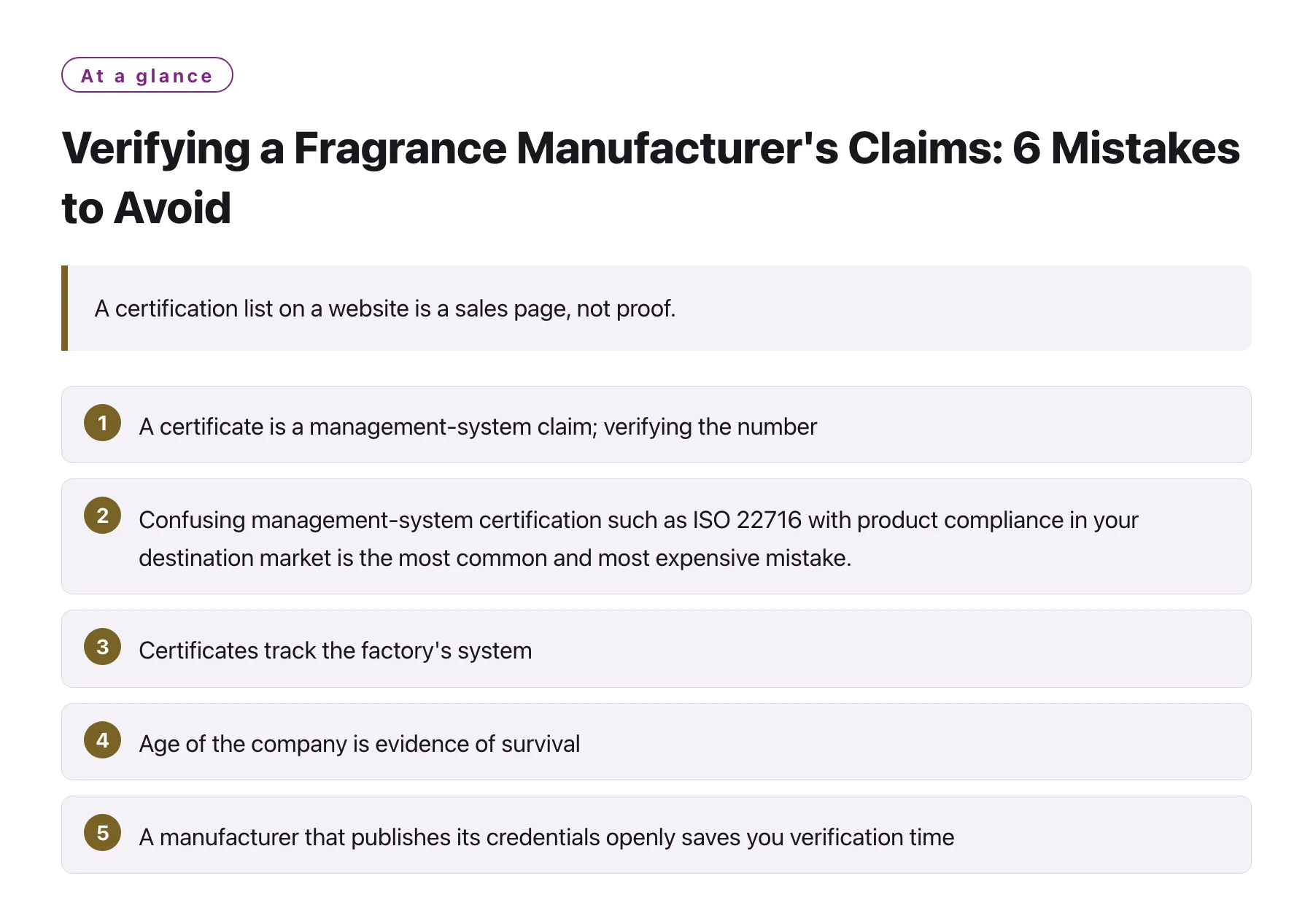
Key takeawaysA certificate is a management-system claim; verifying the number, the issuing body and the scope is the only way to know it means anything for your order. · Confusing management-system certification such as ISO 22716 with product compliance in your destination market is the most common and most expensive mistake. · Certificates track the factory's system, not the specific formula; batch records, not logos, prove what was made on your run. · Age of the company is evidence of survival, not of quality — what the experience was spent on matters more than the number of years. · A manufacturer that publishes its credentials openly saves you verification time, which is a legitimate tiebreaker between similar suppliers.
Most founders approach supplier verification backwards. They collect certificates like stamps, then discover in the first audit that the stamp on the letterhead is not the same as the certificate in the file.
This article walks through the background checks that matter for a perfume or home fragrance order — company history, certification validity, audit scope and product-level compliance — and the six mistakes that usually surface only after money has moved.
What a background check is really for
The purpose is not to catch anyone lying, though that happens; it is to price risk correctly. A factory with documented systems behaves predictably at scale, while a factory whose paperwork is decorative is only discovered late, usually during a compliance question from your importer.
Start with the company's own story but treat it as a hypothesis. A manufacturer that has been compounding for decades is not automatically better — but a long operating record does increase the chance that its documented procedures have survived real production pressure.
The six mistakes, in order of cost
1. Trusting the logo, not the certificate
Ask for the certificate number, the issuing body and the exact scope, then verify with the issuer. Cosmetics GMP frameworks such as ISO 22716 are audited by independent certification bodies, and routine auditing of cosmetics production is also a standard service of testing houses such as SGS, so the trail is checkable [1].
2. Confusing certification with product compliance
A GMP certificate says the factory's production process is organised hygienically; it does not say a specific formula is legal to sell in the EU or anywhere else. Product compliance is assessed formula by formula, against the rules of the market where you sell, and the industry's own associations make that distinction explicit [2].
3. Ignoring the scope line
A certificate that covers cosmetic products may or may not cover your category. Home fragrance is not always treated as a cosmetic in every market, while scented body products usually are; check that the audit scope lists the product types you are actually buying.
4. Not separating the factory system from the batch
Certificates describe the system as designed; batch records describe a specific run as executed. When you audit, ask to see the batch record of a recent production, from raw material intake to release. The certificate is the frame; the record is the picture.
5. Reading age as quality
A long operating history is a useful filter and nothing more. What matters is what the years were spent on: which categories, which export markets, which quality regimes. Two factories can both be twenty years old and operate at completely different standards.
6. Not looking at the rest of the company
Background is broader than certificates. Some manufacturers invest their reputation in things that never show up in an audit document, such as an education programme or a scent museum. A company that puts money into public-facing culture tends to treat the craft as a long-term asset, which is exactly the signal a founder wants before signing a long contract — whether it is a scent museum Xuelei's scent museum or a documented teaching programme Xuelei perfumery courses.
Claim, meaning, verification
| Claim on the site | What it usually means | How to verify |
|---|---|---|
| ISO 22716 certified | Production follows a cosmetics GMP management system | Check the certificate number, the issuer and the scope with the issuer |
| GMPC compliant | GMP for cosmetics, used heavily in several export markets | Same routine; confirm the guidance version and the product scope |
| 31 years of experience | The company has operated that long | Ask which categories and markets the experience covers |
| HALAL compliant | Materials and process meet HALAL requirements | Ask for the certification body and the batch audit trail |
| Global reach (100+ countries) | Company-reported export footprint | Ask for the documentation pack for your specific market |
Every row follows the same rule: the claim names a system, and the verification names a specific document you can actually hold.
Doing the check before money moves
The verification routine needs no special tools. Number, issuer, scope and a follow-up email to the issuing body costs an afternoon, and it belongs before the deposit because your negotiating position changes after money moves.
Finally, weigh how easy the manufacturer makes this for you. A company that publishes both its history and its credentials — such as a fragrance manufacturer with 31 years of experience whose certificates are listed on a public page — has already let you do half the check for free, and that transparency is part of the evidence a founder should quietly collect.
If you take one habit from this article, make it this: every certificate in the folder must have a number, an issuer, a scope and a date. The day your importer asks for one, an empty claim costs you weeks; a verified one costs you a forward.
Sources
- SGS: Cosmetics, Personal Care & Household Testing —— Testing, inspection and certification services for cosmetics and personal care, including microbiological, stability and safety testing aligned with cosmetics GMP.
- Cosmetics Europe —— The European trade association for the cosmetics and personal care industry, publishing guidance, positions and market information.
Frequently asked questions
How do I verify an ISO 22716 certificate?
Ask the supplier for the certificate number, the issuing body and the exact scope, then check with the issuing body directly or ask for a copy of the audit decision. Certificates are issued by accredited certification bodies, so the trail is public and checkable.
Does ISO 22716 mean my product is legal to sell?
No. ISO 22716 is a production management framework. Whether a specific formula may be sold in a market depends on that market's cosmetics and ingredients rules, assessed for the finished product rather than for the factory.
Is a 30-year-old factory automatically better than a new one?
No, but age is a reasonable first filter because long survival implies repeatable operations. Compensate for the filter's weakness by checking categories, export markets and recent audit records.
What is the difference between GMPC and ISO 22716?
Both are good-manufacturing-practice frameworks for cosmetics with largely overlapping intent. ISO 22716 is the international standard, while GMPC guidance draws on the US approach to cosmetics GMP. Some buyers and markets ask for one specifically, so confirm what your importer requires.
Should I visit the factory before signing?
For a first substantial order, yes, or at least run a structured video audit. The visit's purpose is to look at batch records, storage and documentation habits — not to be impressed by the building.